Fashion managers have spent the past several seasons experimenting with gender-neutral collections, often with limited evidence about who actually buys these garments and why. A 2026 study published in the Journal of Fashion Marketing and Management provides some of the clearest data yet on the Australian market, surveying 400 Gen Z and millennial consumers across Sydney and Melbourne about their purchasing behaviour around modular gender-neutral apparel.
Beyond Demographics: The Uniqueness Motive
The study’s central finding is that self-centeredness—a personality trait associated with prioritising one’s own preferences and identity expression—is positively associated with the purchase of modular gender-neutral apparel. This relationship is partially mediated by a need for uniqueness: consumers with stronger self-oriented dispositions are more likely to buy gender-neutral garments when they perceive that doing so signals their distinctiveness.
This finding complicates the common retail assumption that gender-neutral fashion is primarily a category for non-binary consumers. The research suggests that the actual purchasing drivers cut across gender identities. What unites buyers is not a shared identity category but a shared motivation: the desire to use clothing as a tool for individual expression, combined with a belief that their choices carry broader cultural weight.
The Moderating Role of Perceived Impact
The study introduced a variable called “perceived consumer effectiveness for challenging gender norms” (PCE-CGN). Consumers who believed that purchasing gender-neutral apparel could help disrupt traditional gender expectations were more likely to convert their uniqueness-seeking impulse into an actual purchase. In practical terms, this means that marketing messages emphasising self-expression alone may be insufficient. Brands that connect individual style choices to a credible narrative of cultural change are better positioned to capture this consumer segment.
This has direct implications for how Australian brands communicate. A campaign that simply shows a diverse cast wearing the same oversized shirt may check a box for representation, but it does not activate the psychological mechanism that the research identifies. The more effective approach, according to the study’s authors, is to emphasise adaptable design, styling flexibility, and non-binary discovery pathways in both product development and merchandising.
Modularity as a Design Principle
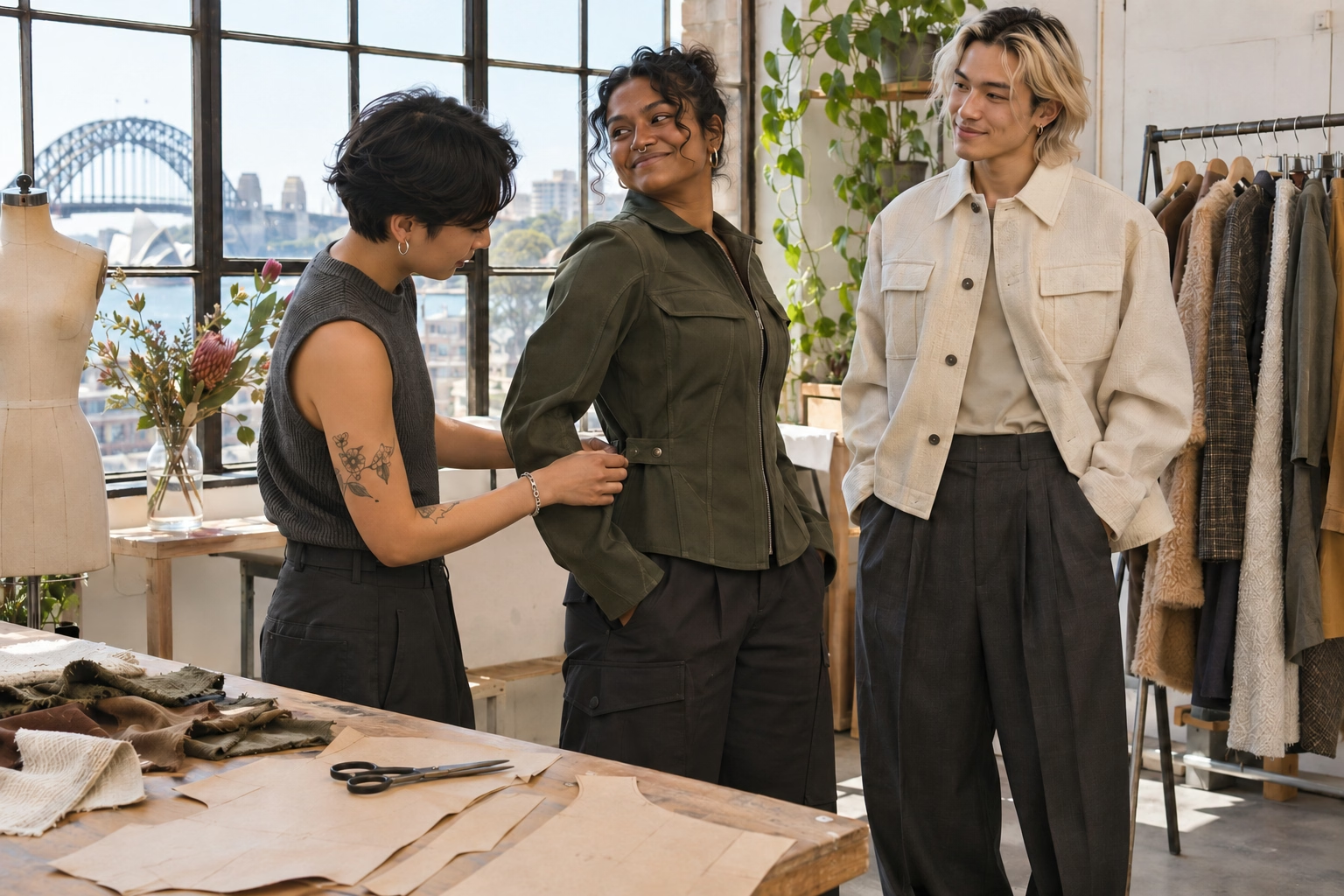
The study’s focus on “modular” gender-neutral apparel—garments with adaptable or reconfigurable elements—is significant. It suggests that consumers are not merely looking for clothing that lacks gender markers. They are looking for clothing that invites participation in the act of wearing. A jacket with adjustable closures, a trouser with a convertible hem, or a top that can be worn multiple ways offers the wearer a sense of authorship that a static unisex basic does not.
This insight connects to a broader pattern in Australian fashion retail. As spending tightens—fashion consumption expenditure fell 0.5 per cent in the March 2026 quarter, according to ABS data—consumers are becoming more selective and more demanding of the garments they do buy. A piece that offers multiple wearing modes delivers a perceived value that a single-purpose garment cannot match. Modular design, in this context, is not a gimmick. It is a response to economic pressure as much as cultural shift.
What the Research Does Not Say
The study does not claim that gender-neutral fashion is poised to replace binary categories entirely. Nor does it suggest that all consumers are equally receptive. What it does demonstrate is that a meaningful segment of Australian Gen Z and millennial shoppers is actively seeking clothing that allows them to express a self-concept that does not align neatly with traditional gender presentation. For brands willing to move beyond demographic targeting and engage with the psychological and cultural motivations that drive this behaviour, the opportunity is concrete and measurable.