Fuel Matters More Than You Think
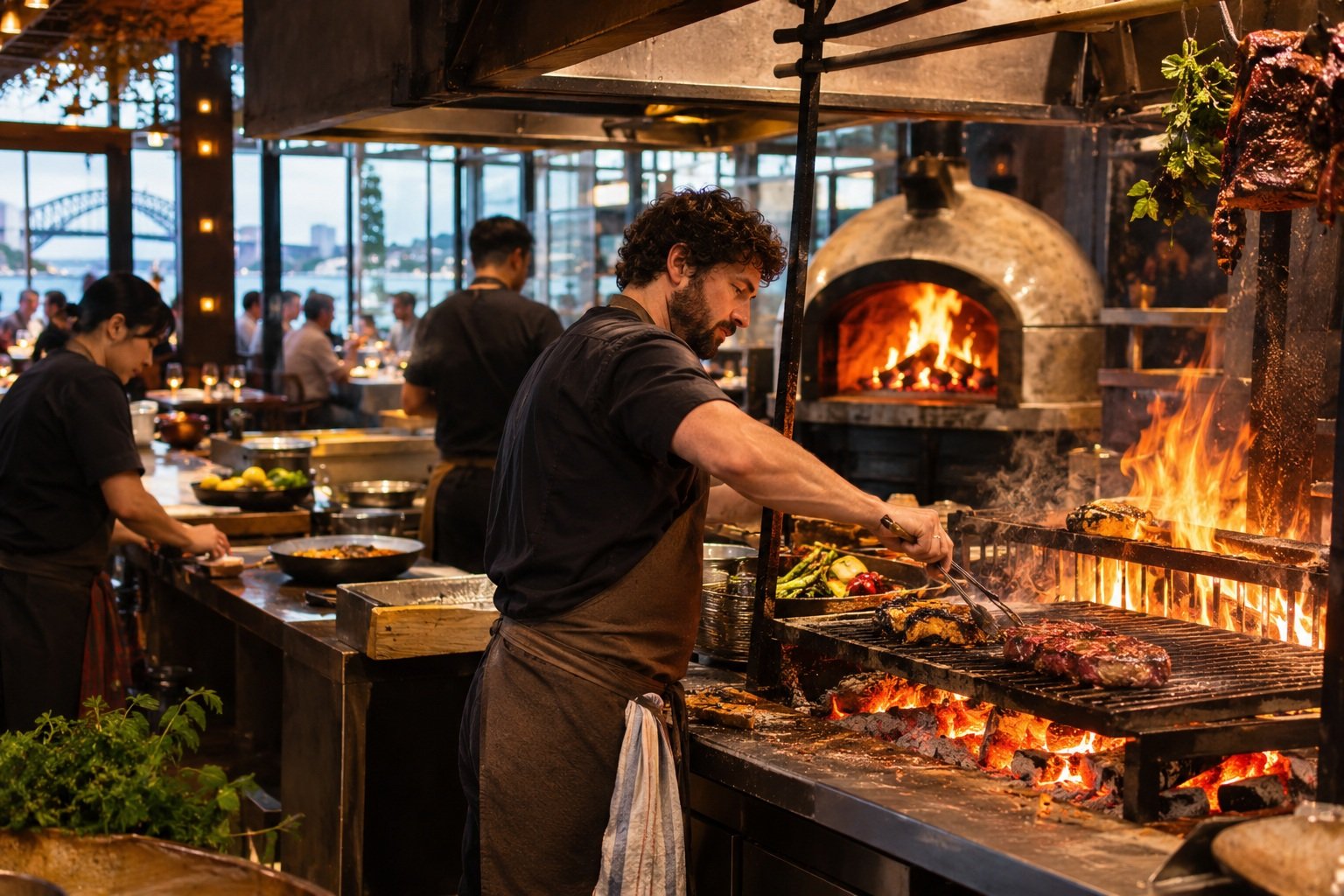
Walk into any serious wood-fired kitchen in Australia and you will find a woodpile that has been thought about as carefully as the wine list. At Pony Dining in Sydney, the signature fuel is ironbark—a dense Australian hardwood that burns hot and long, producing embers that hold temperature without flaring unpredictably. At Agnii in Melbourne, chef Gayan Pieris uses fragrant rivergum and applewood, chosen for the way their smoke interacts with Sri Lankan spices and clay-pot cooking.
The distinction is not academic. Ironbark delivers a clean, intense heat suited to searing and grilling. Fruitwoods like apple and cherry produce a sweeter, gentler smoke that works for longer, slower cooks. Mesquite, used at Wildflame in East Maitland, burns fiercely and imparts a distinctive bitterness that suits beef and game. A chef who ignores fuel selection is a chef who has not understood the assignment.
Temperature as an Ingredient
The difference between good and great wood-fired cooking often comes down to temperature management—a skill that cannot be programmed into a circulator. Keno Perlas, head chef at Rasā House in Rose Bay, told Urban List that “charcoal cooking is delicate,” explaining that the kitchen ensures “our temperature is not too high so our marinade doesn‘t burn”. Proteins are cooked slowly to allow marinades to caramelise; delicate dishes are positioned over coals to balance grilling with gentle steaming.
This is the opposite of the “hot and fast” stereotype that many associate with flame cooking. At Firedoor, Lennox Hastie has built a decade-long reputation on treating fire with the same precision a pastry chef applies to laminating dough. The Sydney Morning Herald’s review of the restaurant noted that it is “still about the grill and the skill, the science and the purity of intent,” with increasing “subtlety and nuance” over the years.
The Clay Pot Variable
Agnii introduces another variable that has no equivalent in conventional kitchens: the accumulated seasoning of clay pots. Pieris explained to Broadsheet that repeated use of the same clay vessels builds “their own character,” adding that “once you break an ancestral clay pot, it‘s a big deal for us”. The porous nature of unglazed clay allows flavours from previous cooks to seep into subsequent dishes, creating a cumulative complexity that stainless steel cannot replicate. For Australian chefs accustomed to sanitised, uniform equipment, this represents a philosophical shift as much as a technical one—cooking with fire means cooking with history.