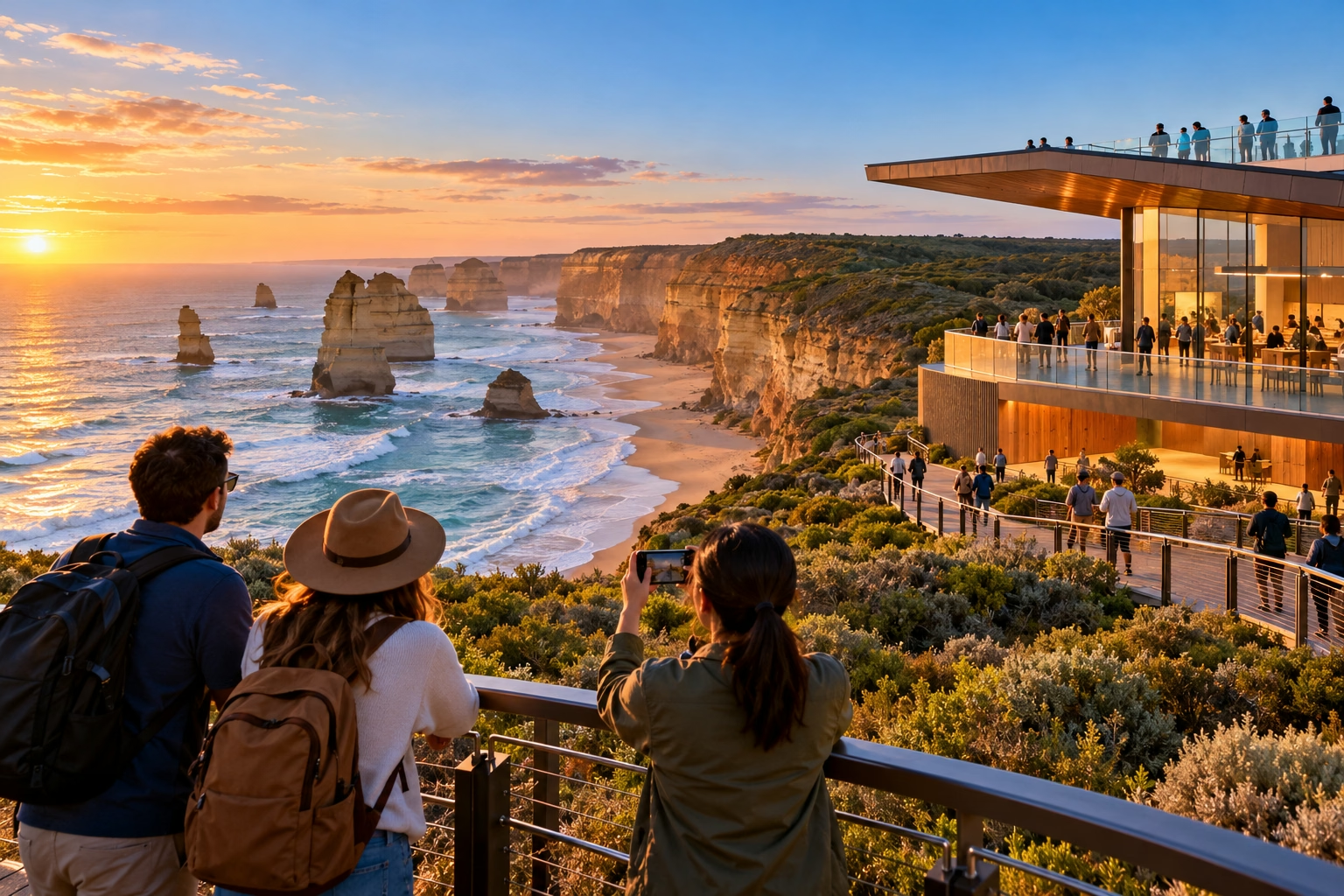
For decades, the Twelve Apostles on Victoria’s Great Ocean Road represented the low-yield regional attraction. Millions of visitors arrived by car or coach, parked informally, took photographs, and left within minutes. The pattern contributed little to the surrounding economy while creating traffic hazards and environmental strain. The $126 million Keerray Woorroong Visitor Centre, opened in October 2026, is a deliberate attempt to break that cycle. The 3,300-square-metre facility includes immersive digital exhibitions, regional dining, retail, and a rooftop viewing platform, supported by nearly 600 formal car parks and 100 bus bays. The infrastructure is designed to convert transient passage into bookable, high-value experiences.
The booking system as a dispersal tool
The most consequential element is not the building but the timed-entry reservation system introduced at the site. By requiring visitors to book a slot, the managing authority can spread peak demand, reduce congestion, and create a revenue stream reinvested into coastal protection and environmental projects. This is a model of visitor demand management that other heavily trafficked regional attractions are watching closely. It reframes infrastructure not as passive capacity but as an active tool for shaping traveller behaviour and maximising regional economic benefit.
The broader investment pipeline
The Twelve Apostles project is the most visible node in a wider infrastructure push. Austrade’s Tourism Investment Monitor tracks a national pipeline that reached $63.4 billion across 346 projects as of mid-2024, with subsequent reporting indicating continued growth into 2026. The Regional Tourism Infrastructure Investment Attraction Strategy identifies pilot regions across every state and territory—from the Canberra Region and the Snowy Region to Katherine Surrounds and Kangaroo Island—to attract foreign direct investment into tourism products that improve visitor access. The strategy recognises that dispersal is not simply a marketing exercise. It requires physical capacity in the regions to absorb visitors who would otherwise remain in the cities.
Jobs, skills, and the local economy
Infrastructure investment also delivers immediate workforce outcomes. The Twelve Apostles redevelopment created more than 750 jobs during construction and provided more than 50 apprentices with trade experience. The visitor centre is expected to support Victoria’s $46.7 billion visitor economy, projected to reach $57 billion by 2030. Yet the infrastructure-led model is not without risk. Large projects can strain local housing and labour markets, and benefits depend on whether regional businesses can capture the spending that improved access enables. The lesson from the Shipwreck Coast is that infrastructure is necessary but insufficient: it must be paired with local business capability, workforce planning, and demand management to deliver durable regional prosperity.