Geography shapes health outcomes in Australia. For many rural, remote, and First Nations communities, distance to services has long meant delayed diagnosis and fragmented care. Technology is steadily rewriting that story by shrinking the space between patients and clinicians, and by enabling culturally safe, locally anchored models.
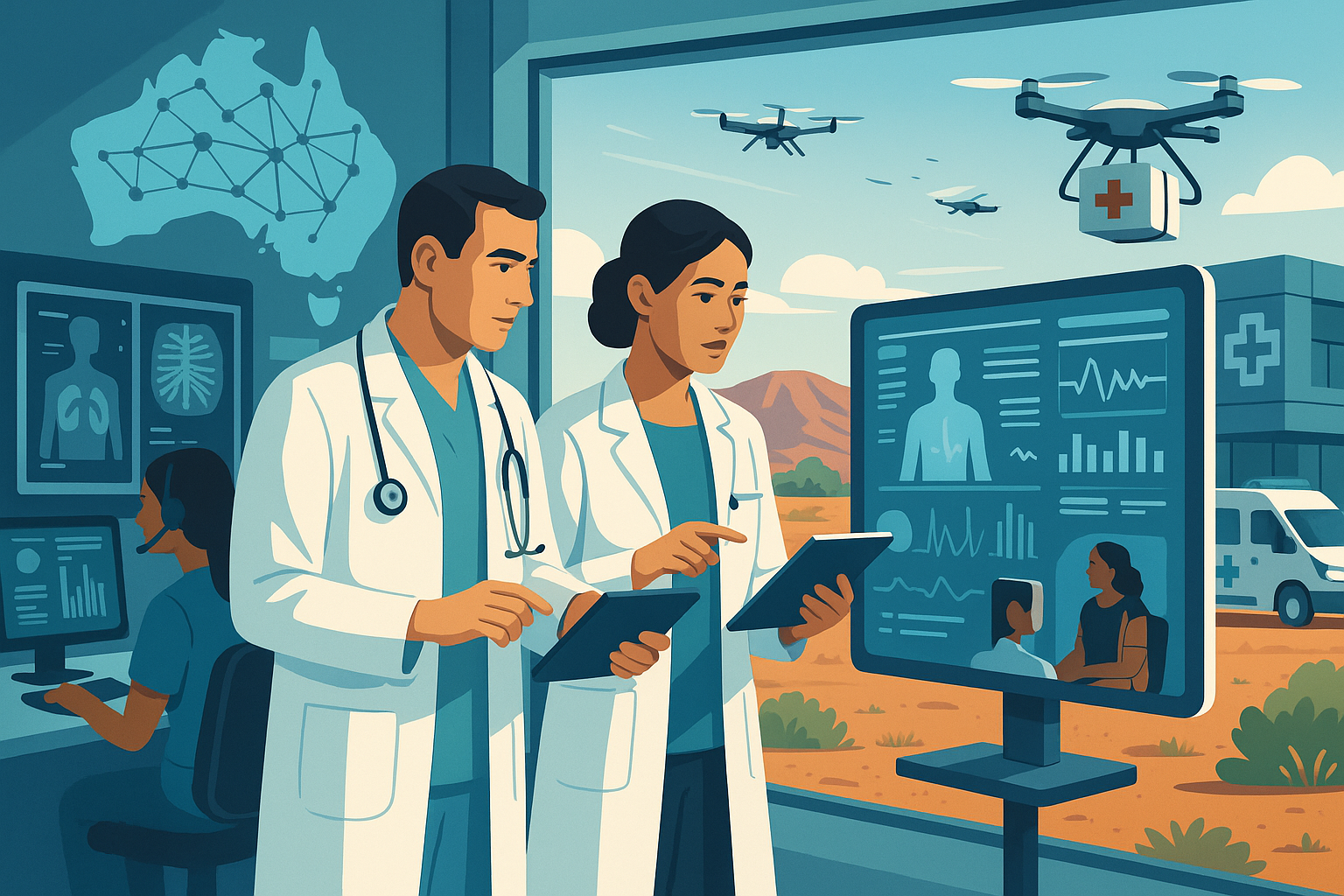
Telehealth, now embedded in Medicare schedules, provides dependable access to GPs, mental health clinicians, and specialists without hours on the road. Nurse-led virtual wards complement these visits, using remote patient monitoring kits—oximeters, scales, spirometers—to stabilise chronic conditions at home. For communities where hospital access is limited, this translates into fewer crises and more continuity.
Diagnostics have moved closer to the point of need. Portable ultrasound, handheld ECGs, and point-of-care tests for HbA1c, INR, and troponin give clinicians actionable insights within minutes. Networked devices send results to cloud systems, where they can be reviewed by metropolitan specialists. When imaging is required, teleradiology turns a local scan into a city-grade report, often within hours.
Digital records tie the network together. My Health Record stores discharge summaries, medications, allergies, and care plans, minimising the risk when patients transition between clinics, Aboriginal Community Controlled Health Organisations (ACCHOs), and hospitals. Interoperability through FHIR standards allows ACCHO systems to integrate with mainstream EMRs while maintaining governance and data sovereignty priorities.
Culturally informed design is critical. Indigenous health workers and community leaders co-create digital education materials in local languages, delivered via SMS, radio, and smartphone apps. Telehealth hubs staffed by trusted local teams help patients navigate technology and interpret medical advice. Where privacy is a concern, spaces are arranged to ensure confidentiality.
Supply chain innovation supports remote care. Temperature-controlled packing, predictive inventory systems, and drone/courier pilots reduce stockouts for essential medicines and vaccines. Critical pathology samples can be moved quickly to reference labs, with results routed back into shared records and flagged for follow-up.
Safety and quality are enforced through regulation and standards. The TGA oversees clinical software where it functions as a medical device, while cybersecurity frameworks and the Notifiable Data Breaches scheme raise the bar for data protection. Training for clinicians includes telehealth etiquette, digital documentation, and escalation protocols.
Funding and research ecosystems bolster sustainability. The Medical Research Future Fund, CSIRO collaborations, and MTPConnect partnerships focus on scalable solutions that can succeed outside major cities. Evaluations measure not only clinical metrics but also patient trust, cultural safety, and workforce impact.
Challenges—connectivity blackspots, device maintenance, and digital inclusion—remain real. Blended models help: community Wi-Fi hubs, loaner devices, and offline-capable apps ensure continuity when signal drops. The goal is not to replace local care but to amplify it, giving communities faster answers, stronger preventive care, and a direct line to specialised support.
Equity is achieved when technology respects place and culture. Australia’s most promising innovations do exactly that: they adapt to community rhythms, strengthen local services, and make high-quality care a right, not a postcode privilege.